
The police have launched a crackdown against the use of directional loudspeakers (devices that focus sound in a specific direction) at religious structures in Mumbai pursuant to a court order.

The Supreme Court has temporarily halted a High Court order that would have sent a decades-old property dispute involving the Bhopal royal estate back to trial court. The case involves descendants of Nawab Hamidullah Khan and challenges the inheritance of Sajida Sultan and her heirs, including actor Saif Ali Khan.

The Supreme Court of India will hear a petition challenging a district court's order to survey a Mughal-era mosque in Sambhal, Uttar Pradesh. The petition alleges that the hasty survey has led to communal tensions and violence, resulting in deaths and injuries. The petitioners argue that the survey was ordered without proper notice or hearing, and they seek a stay on the proceedings and a directive to prevent such surveys from being ordered as a matter of course in cases involving disputes over places of worship.

A plea has been filed in the Supreme Court over alleged "blatant hate speeches" calling for killing Muslims and their social and economic boycott delivered at rallies in different states, including Haryana where recent communal clashes claimed six lives.
The Election Commission defended its Special Intensive Revision (SIR) exercise for Bihar's voter list in the Supreme Court, calling it accurate and dismissing allegations of impropriety by political parties and NGOs.
Congress MP Mohammad Jawed and AIMIM president Asaduddin Owaisi have challenged the validity of the Waqf (Amendment) Bill, 2025 in the Supreme Court, arguing that it violates constitutional provisions. The petitions claim the bill imposes arbitrary restrictions on Waqf properties and their management, undermining the religious autonomy of the Muslim community. They also allege that the bill discriminates against Muslims by imposing restrictions not present in the governance of other religious endowments. The bill was passed in the Rajya Sabha and Lok Sabha, with the petitioners arguing that it introduces limitations on the creation of Waqfs based on the duration of one's religious practice, mandates inclusion of non-Muslim members in Waqf administrative bodies, and shifts key administrative functions to government officials, thereby diluting the autonomy of Waqf management.

Family members of Kamal Ahmad Vakil Ahmad Ansari, who died awaiting justice in the 2006 Mumbai train blasts case, read aloud the Bombay High Court's acquittal order at his grave, publicly affirming his innocence and demanding accountability from the system.
President Droupadi Murmu has given her assent to the Waqf (Amendment) Bill, 2025, which has sparked controversy and legal challenges. The Bill, passed by Parliament after heated debates, has been criticized by opposition parties as "anti-Muslim" and "unconstitutional". The government, however, maintains that the reform will benefit the Muslim community. Several petitions have been filed in the Supreme Court challenging the constitutional validity of the Bill, alleging discrimination against Muslims and undermining their religious autonomy. The Bill repeals the Mussalman Wakf Act, 1923, and introduces restrictions on Waqf properties and their management, which have raised concerns about the impact on the Muslim community.
The matter came up for hearing on Friday before a vacation bench of justices Vikram Nath and SVN Bhatti, which allowed the petitioner to withdraw the plea.

The Supreme Court expressed its disapproval of an analogy used by the Centre in support of the inclusion of non-Muslims in Waqf boards, stating that such logic would disqualify a bench of Hindu judges from hearing matters related to Waqf. The CJI questioned the Centre's stance on the provisions of the Waqf (Amendment) Act, 2025, which allows non-Muslim members in the Central Waqf Council and state waqf boards. The Solicitor General defended the provisions, emphasizing that the non-Muslim inclusion is limited and does not impact the Muslim composition of these bodies. However, the CJI asserted that judges shed their religious affiliations while serving on the bench and maintained their secularity in their judicial capacity.

The fresh plea, filed through lawyer Ashwani Dubey, seeks dismissal of the pending PILs of various petitioners including the Indian Union Muslim League on various grounds.

The court said the judiciary showing tolerance towards matters with anti-national overtones is leading to a rise in the number of such cases.
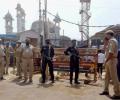
The Muslim side in the Gyanvapi mosque-Shringar Gauri complex case on Thursday filed an objection in the court against the Hindu plaintiffs' plea for the carbon dating of the "Shivling" claimed to be found on the masjid premises.

A bench of justices Hrishikesh Roy and S V N Bhatti is likely to hear the plea filed by NGO Association of Protection of Civil Rights.
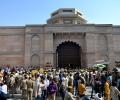
The Supreme Court of India is scheduled to hear a batch of petitions challenging the validity of certain provisions of the Places of Worship (Special Provisions) Act, 1991, which prohibits lawsuits to reclaim a place of worship or change its character from what prevailed on August 15, 1947. The pleas, including one filed by Ashwini Upadhyay, argue that these provisions violate the right to judicial remedy and create an arbitrary cut-off date. The matter will be heard in the backdrop of several ongoing cases related to places of worship, including the Gyanvapi Mosque in Varanasi and the Shahi Idgah Mosque in Mathura. The Muslim side has cited the 1991 law to argue that such suits are not maintainable. The Supreme Court had previously sought the Centre's response to Upadhyay's petition, which alleged that the law creates an "arbitrary and irrational retrospective cut-off date" for maintaining the character of places of worship.

The plea filed by the Hindu side has stated that the cellar's roof is very old and weak.

The Supreme Court of India began hearing a batch of petitions challenging the constitutional validity of the Waqf (Amendment) Act, 2025. The bench, led by Chief Justice Sanjiv Khanna, asked both sides to address whether the court should entertain the petitions or relegate them to the high court. The hearing is underway with senior advocate Kapil Sibal arguing for the petitioners. The act, which was passed by Parliament following heated debates, has been challenged by various parties including AIMIM leader Asaduddin Owaisi, All India Muslim Personal Law Board (AIMPLB), and Jamiat Ulama-i-Hind.
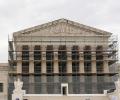
The US Supreme Court has denied the application of Tahawwur Rana, a Canadian national of Pakistani origin accused in the 2008 Mumbai terror attacks, seeking a stay on his extradition to India. Rana, currently detained in Los Angeles, had submitted the application after Associate Justice Elena Kagan initially denied it. Despite a renewed appeal, the Supreme Court ultimately rejected the request.
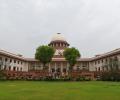
The Indian government has defended the Waqf (Amendment) Act, 2025 in the Supreme Court, arguing that there cannot be a blanket stay on the law as there is a presumption of its constitutionality. The Centre countered the pleas challenging the law's validity, asserting that the amendments were undertaken after a comprehensive study by a parliamentary panel. The government also highlighted the "reported misuse" of earlier provisions and the increase in waqf land, claiming that over 20 lakh hectares were added after 2013.
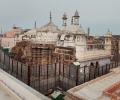
The court has also directed all concerned parties to file objections to the report submitted by the commission that surveyed the mosque premises.

Tahawwur Rana, accused in the 2008 Mumbai terror attacks, has renewed his plea for a stay on his extradition to India, citing health concerns and alleging potential torture. He argues that his extradition would violate US law and the UN Convention Against Torture. Rana's lawyers claim he is at risk of being subjected to torture in Indian detention facilities due to his Pakistani origin, Muslim religion, and medical conditions. The US Supreme Court had previously denied his emergency bid for a stay, but he has now appealed to Chief Justice John Roberts. The US government has declined to provide information on any commitment from India regarding Rana's treatment, further fueling his concerns.
Underscoring the 'presumption of constitutionality in favour of law', the Supreme Court on Tuesday said petitioners challenging the waqf law needed a 'strong and glaring' case for interim relief.
Tahawwur Rana, accused in the 2008 Mumbai terror attacks, has renewed his application to the US Supreme Court seeking a stay of his extradition to India. The Supreme Court will hear the application next month. Rana, currently detained in Los Angeles, claims his extradition would violate US law and expose him to torture in India due to his health and Muslim background. The US government has denied these claims and authorized his surrender to India, citing the Extradition Treaty between the two countries. The Supreme Court's decision will determine if Rana will face justice in India or remain in the United States.
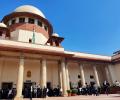
The bench said it cannot accede to the prayer made in the petition, which amounts to giving equal rights in succession irrespective of the religion.

The Centre on Wednesday told the Supreme Court that nobody can claim right over government land and it is legally empowered to reclaim properties which are declared waqf by using the waqf by user principle.

The Centre on Thursday assured the Supreme Court that it will neither denotify Waqf properties, including "Waqf by user", nor make any appointments to the central Waqf council and boards till May 5.

The application, filed by the Indian Union Muslim League (IUML), which is one of the petitioners who have challenged the citizenship law, has sought the court's direction to ensure no coercive action is taken against people belonging to the Muslim community pending adjudication of the writ petitions. Muslims cannot apply for Indian citizenship under the CAA.
The Supreme Court of India has reserved its interim orders on three key issues related to the Waqf (Amendment) Act, 2025, including the power to denotify waqf properties, the composition of waqf boards, and the provision regarding government land. The court heard arguments from both the petitioners, who challenged the validity of the amended law, and the Centre, which defended the Act as a secular concept. The petitioners sought interim orders to prevent the implementation of certain provisions while the court considers the legal challenges.

A bench of Chief Justice DY Chandrachud and Justices JB Pardiwala and Manoj Misra will hear the plea of Anjuman Intezamia Masajid Committee.

BJP leader PC George was granted bail by a court in Kottayam, Kerala in a hate speech case. George had surrendered before the court on Monday and was remanded to police custody. The High Court had rejected his anticipatory bail plea, observing that granting bail would send the wrong message to society. George was accused of delivering a hate speech against a minority community during a TV channel discussion. He was booked under sections 196(1)(a), 299 of the Bharatiya Nyaya Sanhita, and section 120(o) of the Kerala Police Act.

The mayor of Darbhanga, Bihar, has sparked a controversy by suggesting a two-hour break in Holi celebrations to accommodate Friday prayers during Ramzan. Her proposal has drawn criticism from a BJP MLA, who accused her of calling for 'Ghazwa-e-Hind'. Meanwhile, other politicians have condemned the mayor's suggestion and emphasized the need for communal harmony.

Instant 'triple talaq', also known as 'talaq-e-biddat', is an instant divorce whereby a Muslim man can legally divorce his wife by pronouncing 'talaq' three times in one go.

A court in Baghpat on Monday dismissed a decades-old plea filed by a Muslim side over a site that Hindu devotees say is the Mahabharat-era 'Lakshagriha' but the petitioners maintain is a graveyard and dargah of Sufi saint Sheikh Badruddin.
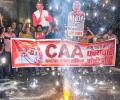
The Supreme Court on Friday agreed to hear on March 19 the pleas seeking a direction to the Centre to stay the implementation of the Citizenship Amendment Rules, 2024 till the apex court has decided the petitions challenging the constitutional validity of the Citizenship (Amendment) Act, 2019.

The Supreme Court agreed to hear on Friday a plea challenging the Allahabad high court order of conducting a 'scientific survey', including carbon dating, to determine the age of a 'Shivling' which was said to have been found at the Gyanvapi mosque complex in Varanasi.
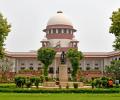
The Supreme Court slammed the Uttar Pradesh government on Friday for not counselling students who were allegedly instructed by their school teacher to slap a Muslim boy for not doing his homework.

The Supreme Court of India has dismissed a plea seeking directions to states to take immediate action against mob lynching and cow vigilantism, particularly against Muslims. The court stated that it was not feasible to "micro-manage" such incidents from Delhi and referred to its 2018 verdict, which issued guidelines to address mob violence and cow vigilantism. The court also noted that the new Bharatiya Nyaya Sanhita (BNS) criminalizes mob lynching as a separate offence. The plea argued that there was "gross non-compliance" with the 2018 directions, but the court maintained that authorities were bound by its previous rulings.
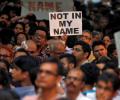
The Supreme Court on Friday agreed to hear a plea filed by a women's organisation seeking directions to states to take immediate action in consonance with a 2018 verdict of the apex court to effectively deal with incidents of lynching and mob violence against Muslims by cow vigilantes.
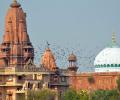
On the recent decision allowing survey of the Gyanvapi mosque, Madani said, "We have no objection to the survey. We believe that if the survey is conducted honestly, nothing will come out of it."

The Varanasi district court arrived at the decision of allowing 'puja' in a Gyanvapi mosque cellar in "haste", the All India Muslim Personal Law Board (AIMPLB) said on Friday, asserting it would pursue the matter right up to the Supreme Court.
